Color guide · Lilac, isabella & new shade
Lilac French Bulldog: genetics, isabella, and a color calculator
A lilac French Bulldog, also called isabella, is a pale silvery taupe, the palest and rarest of the widely-recognized Frenchie base colors. The twist is that lilac is not its own gene at all. It is blue and chocolate at the same time, a dog that has doubled up two separate recessive genes at once. Here is what lilac is, how the double-recessive genetics work, why two non-lilac dogs can still produce one, and how to predict a pairing before you plan it.
What is a lilac French Bulldog?
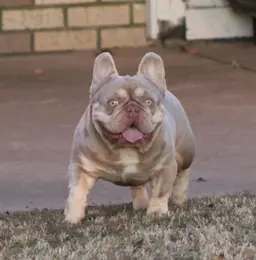
Lilac is a pale, ghostly silvery taupe, the lightest of the exotic Frenchie colors. It reads almost purple-grey in some light, which is where the name comes from. Unlike blue or chocolate, lilac is not a single gene you can point to. It only shows up when a dog is diluted and brown at the same time, so lightening already-brown pigment down to that unmistakable soft taupe tone.
Because it needs two recessive colors to stack, lilac sits at the top of the market and is often the base under the rarest stacked names you see advertised. Lilac and isabella are the same color, two names for one double-dilute coat.
The genetics: blue plus chocolate at once
Lilac is what you get when a dog is homozygous recessive on two separate loci at the same time. It is not a lilac gene, it is a blue dog and a chocolate dog rolled into one. To be lilac, a Frenchie has to be doubled up on both of these:
- Dilution (d/d, the blue gene, MLPH): two copies of the dilution allele, the same gene that makes a black dog blue.
- Brown (b/b, or cocoa co/co): two copies of a brown allele, the same genes that make a black dog chocolate. Either the testable-chocolate gene (b on TYRP1, the "rojo" brown) or the separate cocoa gene (co on HPS3) will do it.
- Both at once: only when a dog is d/d and b/b (or co/co) does the dilution act on brown pigment, and that combination is what produces the pale lilac tone. Miss either one and the dog is simply blue, or simply chocolate, not lilac.
Lilac and isabella are the same result, just two labels for the same double-recessive coat. Because four recessive alleles have to line up in one dog, lilac is genuinely the rarest of the common base colors, not a matter of marketing.
Can two non-lilac French Bulldogs produce a lilac puppy?
Yes, and this is the part that surprises people. Two dogs that are visually neither blue nor chocolate can still produce a lilac, as long as both parents carry both blue and chocolate (D/d B/b). Each recessive gene has to double up independently, so a pairing of two dual carriers throws a lilac only about one puppy in sixteen. That is exactly why lilac feels to appear out of nowhere: the carriers hid in plain sight.
You cannot eyeball this. The only reliable way to know is a DNA test of both the dilution and brown genes on both parents before you plan the litter. To watch it happen, you can load two dual-carrier parents in the color calculator and see a lilac appear in the odds even though neither parent looks lilac.
Lilac vs isabella, and the rarest stacks
Lilac and isabella are not two different colors, they are two names for the identical double-dilute coat. Whichever word a breeder uses, the genetics underneath are the same d/d plus b/b combination.
Because lilac is already rare, the market pushes it further by stacking other genes on top of it. A lilac merle (isabella merle) adds a dominant merle allele over the lilac base, and a fluffy lilac adds the recessive long-coat gene. Each of these needs even more uncommon genes to line up on an already scarce base, which is why they sit at the very top of the Frenchie market.
New shade isabella: the cocoa triple dilute
"New shade" is the term Frenchie breeders use for a newer, warmer isabella that emerged around 2019 to 2020. A standard isabella is blue plus testable chocolate (d/d b/b). A new shade isabella adds the cocoa gene on top of that, so the dog is diluted (d/d), testable chocolate (b/b), and cocoa (co/co) all at once, a "triple dilute." Layering cocoa over the standard isabella shifts the coat from a cool silvery taupe toward a warmer, goldish tone, usually paired with light amber, green, or blue eyes.
Because a new shade stacks a third recessive gene onto an already scarce double dilute, it is one of the hardest colors to produce on purpose, which is exactly why it commands the highest prices. Doing it reliably means DNA testing all three genes (dilution, testable chocolate, and cocoa) on both parents and then working the odds, which is where the color calculator earns its keep.
Are lilac French Bulldogs AKC registered?
Registration and show eligibility are two different questions, and it is easy to conflate them:
- Registration: a lilac with two registered French Bulldog parents can be AKC registered as a purebred, and it is accepted by other registries too.
- The show ring: lilac is a disqualification under the AKC French Bulldog standard, so a lilac cannot earn a conformation championship.
As with the other in-demand colors, disqualification is a show classification, not a statement that the dog is unhealthy or unregisterable.
Health of lilac French Bulldogs
The lilac color itself is cosmetic. The one color-linked note worth knowing is that, because lilac is doubly dilute, color-dilution alopecia (CDA) can affect some lilacs, a thinning or patchy coat over the dilute areas. It is manageable and not universal, the same note that applies to blue, but it is worth asking a breeder to disclose.
Beyond that, a lilac carries the same breed-wide considerations every French Bulldog owner should know about, around airway, spine, and joint health. The color changes the coat, not the dog underneath.
Price and demand
Lilac is one of the most expensive Frenchie base colors precisely because so many recessive genes have to align to make one. Scarcity and demand set the price, not health or quality. As with every exotic color, the way to buy a lilac confidently is to see both parents' DNA panels and confirm the dilution and brown results, not to pay a premium on the look alone.
Predict your exact pairing
Stop guessing carrier odds on scratch paper. If you know your parents' dilution and brown status, load them into the engine below to generate exact litter odds, visual phenotype breakdowns, the CDA health note, and the full AKC standard-versus-disqualification split instantly.
Lilac French Bulldog: common questions
There is none. Lilac and isabella are two names for exactly the same color, a pale silvery taupe that comes from a French Bulldog being blue and chocolate at the same time. Some breeders and regions favor the word lilac, others favor isabella, but genetically they describe the identical double-dilute coat.
Lilac is not its own gene. It only appears when a dog is homozygous recessive on two separate loci at once: two copies of the dilution gene (d/d, the blue gene) and two copies of the brown gene (b/b, or the cocoa variant co/co). That means four recessive alleles have to line up in one dog, so both parents must carry both blue and chocolate for a lilac to be possible at all, which makes it far scarcer than any single-gene color.
New shade isabella is a warmer, more golden isabella that adds the cocoa gene to a standard isabella. A regular isabella (lilac) is blue plus testable chocolate (d/d b/b); a new shade is diluted, testable chocolate, and cocoa all at once (d/d b/b co/co), a triple dilute that first appeared in the breed around 2019 to 2020. Stacking a third recessive gene onto an already rare base makes new shade one of the most expensive and hardest colors to produce, and it requires DNA testing all three genes on both parents.
Yes. If both parents carry both blue and chocolate while looking like neither (D/d B/b), roughly one puppy in sixteen can be lilac, because each of the two recessive genes has to double up independently. The only way to know before breeding is a DNA test of both the dilution and brown genes on both parents.
The color itself is cosmetic. Because lilac is doubly dilute, though, color dilution alopecia can affect some lilacs, a thinning or patchy coat over the dilute areas that is manageable and not universal, and worth asking a breeder to disclose. Otherwise a lilac carries the same breed-wide considerations as any French Bulldog around airway, spine, and joints.
A lilac with two registered French Bulldog parents can be registered with the AKC as a purebred. Lilac is, however, a disqualification in the AKC show ring, so it cannot earn a conformation championship. Registration and show eligibility are two different questions, and disqualification is a show classification, not a health or registration verdict.