Color guide · Merle (M locus)
Merle French Bulldog: genetics, the double-merle risk, and a color calculator
A merle French Bulldog has a mottled, patchy coat where a dominant gene randomly dilutes patches of the base color. It is one of the most sought-after and most expensive Frenchie patterns, and the only coat color that comes with a genuine, serious health warning. Here is what merle is, how the genetics work, why you must never pair two merles, and how to predict a pairing before you plan it.
What is a merle French Bulldog?
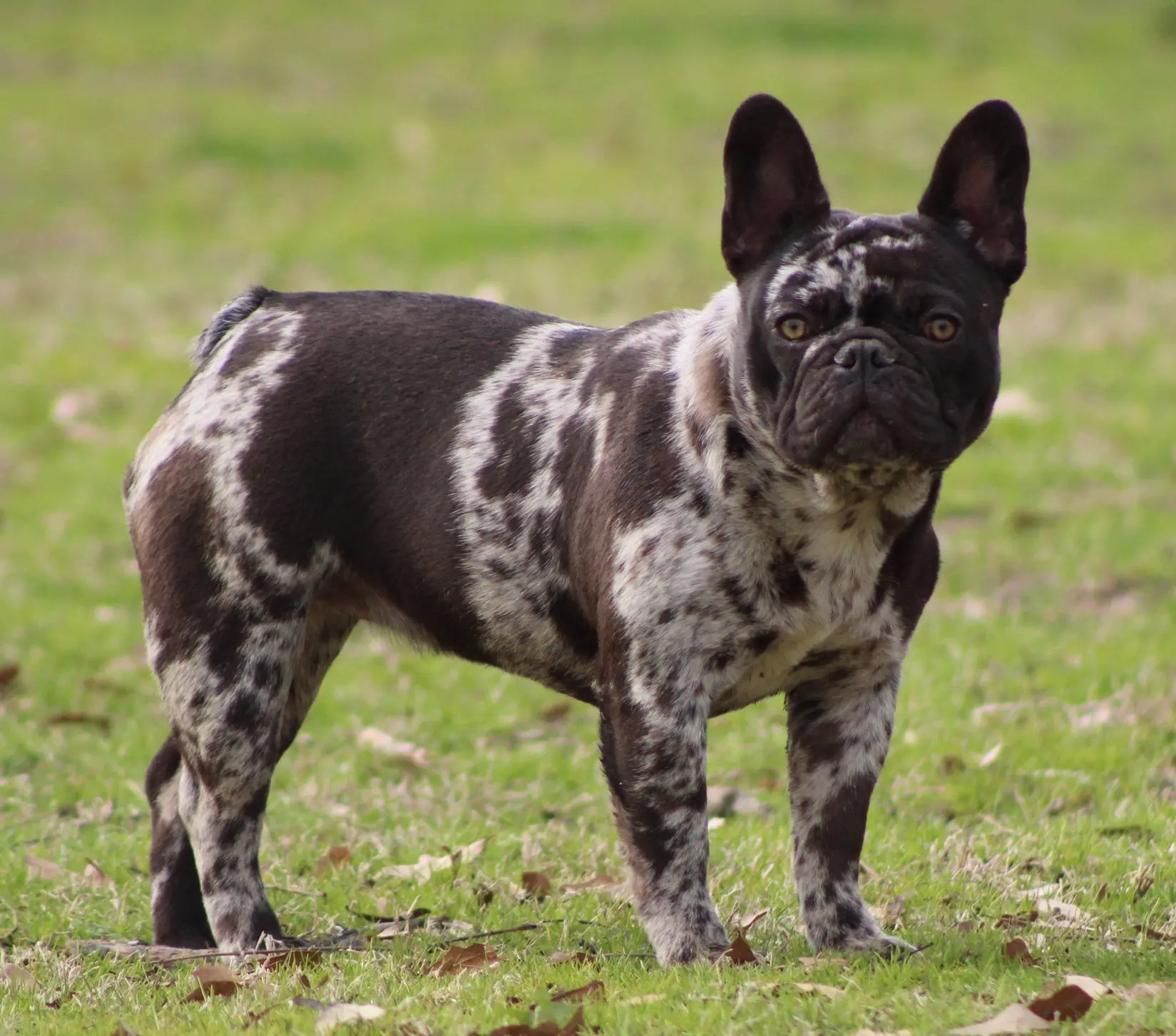
Merle is a coat pattern, not a single color. A merle gene takes a dog's base color and randomly lightens patches of it, leaving an irregular, marbled mix of full-strength and diluted pigment. On a black base that reads as a blue-grey marble; on a lilac base it reads as a pale silver patchwork. The pattern can also lighten eye color and skin pigment, which is why merles often have blue or split-colored eyes.
Because merle sits on top of whatever base color a dog already has, it stacks with the dilution and brown genes to create the high-demand names you see advertised: blue merle, chocolate merle, and lilac (isabella) merle. It is a pattern layered over a color, never a color on its own.
The genetics: the M locus (PMEL gene)
Merle is controlled by the PMEL gene, usually called the M locus. Unlike blue or chocolate, merle is dominant, so a dog only needs one copy to show the pattern. A dog's M-locus status is one of three things:
- Non-merle (m/m): no merle gene, solid base color, cannot pass merle on.
- Merle (M/m): one copy, shows the merle pattern, passes merle to about half its puppies. This is a healthy, single-dose merle.
- Double merle (M/M): two copies, usually mostly white, and at high risk of deafness and eye defects. This is the outcome to avoid.
Because merle is dominant, it cannot skip a generation the way a recessive color can. A visibly merle dog has at least one merle parent, and a truly non-merle dog cannot suddenly throw a merle puppy, with one important exception covered below: cryptic merle.
The double-merle danger: never breed merle to merle
This is the single most important thing on the page. Breeding two merle dogs together (M/m x M/m) gives, on average, one in four puppies two copies of the merle gene (M/M), the double-merle result. Double merles are strongly linked to deafness, blindness, microphthalmia (undersized eyes), and other serious defects. This is a genetics decision, not an aesthetic one.
The safe way to produce merle puppies is to pair one merle (M/m) with a non-merle (m/m). Every puppy then inherits either a single merle dose or none at all, and no puppy can be double merle. The calculator raises a dedicated warning the moment both parents are set to merle, so you can see exactly what a merle-to-merle pairing produces and why it is off the table.
Cryptic merle: the hidden trap
The merle gene comes in different lengths, and shorter versions can produce little or no visible pattern. A dog like this is called a cryptic or phantom merle: it carries merle but looks like a solid, non-merle dog. The risk is obvious once you see it. A breeder who mistakes a cryptic merle for a solid dog can unknowingly pair it with a visible merle and produce double-merle puppies.
You cannot eyeball this. A merle DNA test reports both whether a dog carries merle and the length of the allele, which is the only reliable way to clear a suspected cryptic merle before breeding.
Are merle French Bulldogs AKC registered?
Registration and show eligibility are two different questions, and merle also carries a purity debate the other exotic colors do not:
- Registration: a merle with two registered French Bulldog parents can be AKC registered. Some breeders and purists dispute merle's place in the breed because it is widely believed to have entered the gene pool through historic outcrossing.
- The show ring: merle is a disqualification under the AKC French Bulldog standard, so a merle cannot earn a conformation championship.
As with the other in-demand colors, disqualification is a show classification, not a statement that the dog is unhealthy or unregisterable.
Health of merle French Bulldogs
A single-merle (M/m) Frenchie is generally as healthy as any other, because the pattern itself is cosmetic. The health problems are tied almost entirely to the double-merle (M/M) genotype that comes from irresponsible merle-to-merle pairings, not to merle as such. That is why the whole responsible-breeding conversation around merle is really a conversation about avoiding two copies.
Merles carry the same breed-wide considerations every French Bulldog owner should know about (airway, spine, and joint health), and if the merle base is also dilute (a blue or lilac merle), the color-dilution alopecia note from those colors applies too.
Price and demand
Merle is one of the most expensive Frenchie patterns because it is visually dramatic and heavily marketed, and the stacked combinations (lilac merle, fluffy merle) are genuinely rare because they require several uncommon genes to line up at once. None of that changes the core rule: the way to buy a merle confidently is to see the parents' DNA panels and confirm a single-merle, non-double-merle pairing, not to pay a premium on looks alone.
Predict your exact pairing
Stop guessing carrier odds on scratch paper. If you know your parents' M-locus status, load them into the engine below to generate exact litter odds, visual phenotype breakdowns, the double-merle health alert, and the full AKC standard-versus- disqualification split instantly.
Merle French Bulldog: common questions
This is debated. Merle is a dominant coat pattern that is not native to the traditional French Bulldog gene pool, and many breed historians believe it was introduced through outcrossing to another breed generations back. A modern merle Frenchie from two registered French Bulldog parents can still be AKC registered, but merle is a disqualification in the show ring and many breed purists do not consider it a traditional Frenchie color. Whether you view it as purebred depends on which line you buy from and how far back you trace it.
Breeding two merle dogs (M/m x M/m) gives, on average, one in four puppies two copies of the merle gene (M/M), called double merle. Double merle is strongly linked to deafness, blindness, and serious eye deformities. It is the one pairing coat genetics tells you to avoid outright. To produce merle puppies safely, pair one merle with a non-merle so no puppy can inherit two copies.
A cryptic (or phantom) merle carries the merle gene but shows little or no visible merle patterning, often because of a shorter merle allele. The danger is that a cryptic merle can be mistaken for a solid non-merle and accidentally bred to a visible merle, producing double-merle puppies. A DNA test is the only reliable way to know a dog's true merle status before a pairing.
Merle Frenchies are among the most expensive because the pattern is visually striking and in high demand, and rare merle combinations like lilac merle or fluffy merle sit at the very top of the market. Price reflects demand and scarcity, not health or quality, so a responsible merle breeder should always be able to show DNA results confirming a single-merle, non-double-merle pairing.
No. Merle is a disqualification under the AKC French Bulldog breed standard, so a merle Frenchie cannot compete in AKC conformation. It can still be registered as a purebred if both parents are registered French Bulldogs, and it is accepted by some other registries. Disqualification is a show-ring classification, not a health or registration verdict.