Color guide · Blue (D locus)
Blue French Bulldog: genetics, health, and a color calculator
A blue French Bulldog has a soft blue-grey coat created when a recessive gene dilutes the dog's black pigment. It is the most in-demand of the exotic Frenchie colors and the one most buyers ask for first. Here is what blue actually is, how the dilution genetics work, why blue puppies appear from two normal-looking parents, and how to predict a pairing before you plan it.
What is a blue French Bulldog?
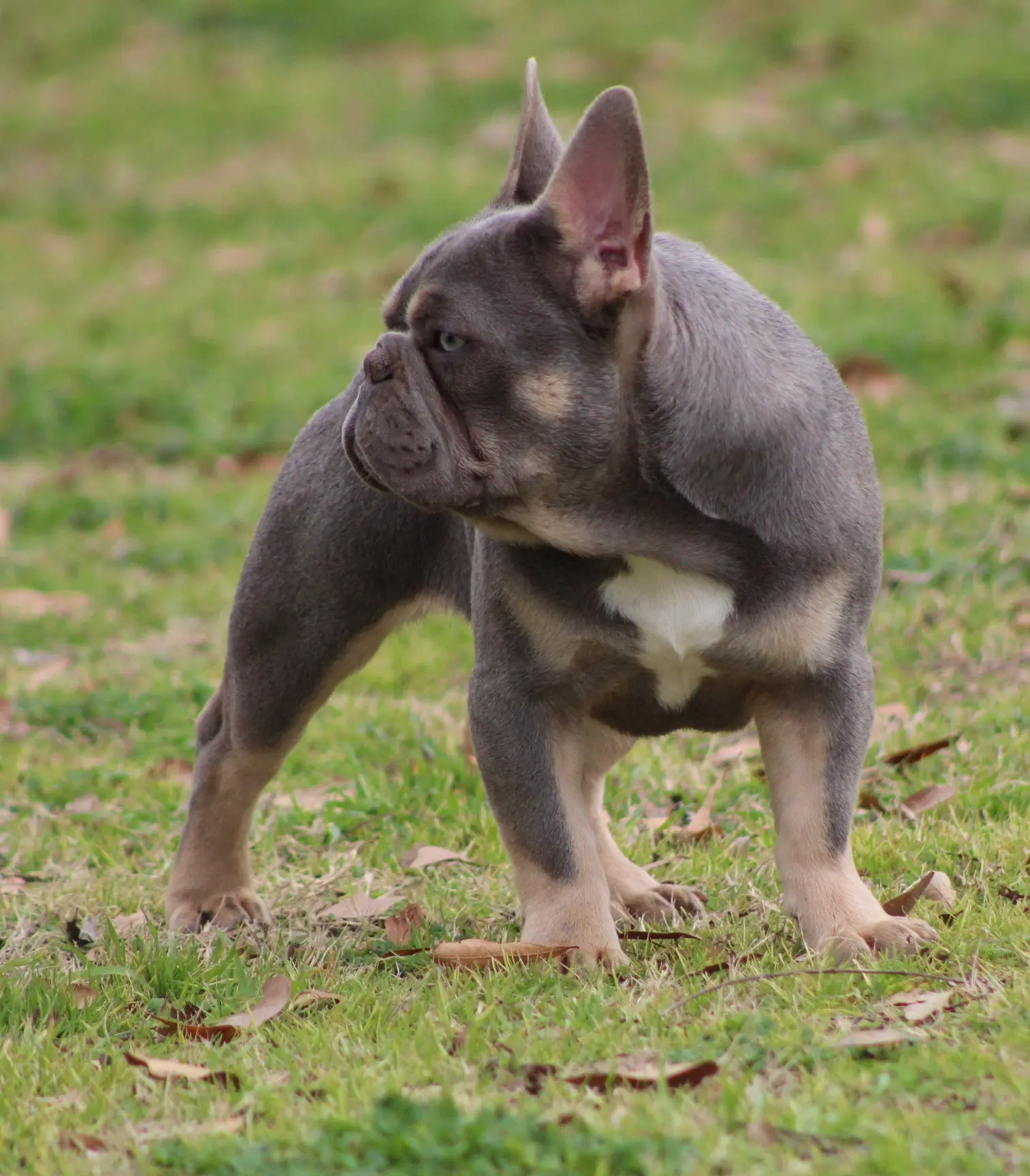
Blue is not a pigment. It is what black eumelanin looks like once a dilution gene softens it, turning a jet-black coat into a smoky blue-grey. The same dilution acting on a chocolate base produces a lilac French Bulldog, which is why blue and lilac lines are so closely related. A blue Frenchie is a normal black-based dog whose black has simply been toned down.
Because blue is a dilution of the base color rather than a pattern layered on top, it changes the whole coat evenly. It commonly pairs with lighter eye color and lighter nose and paw-pad pigment, which is part of the look buyers are drawn to.
The genetics: the D locus (MLPH gene)
Blue is controlled by the MLPH gene, usually called the D locus for dilution. Unlike merle, blue is recessive, so a dog has to inherit two copies before it looks blue. A dog's D-locus status is one of three things:
- No dilution (D/D): no dilution gene, full-strength black pigment, cannot pass blue on.
- Carrier (D/d): one copy, looks completely normal, but passes dilution to about half its puppies. This is the hidden status that surprises breeders.
- Blue (d/d): two copies, the dilution shows, and the dog reads as blue-grey.
Because blue is recessive, it can sit hidden in a line for generations and then surface when two carriers happen to be paired. That is the opposite of a dominant pattern, which always shows in at least one parent.
Can two non-blue French Bulldogs have a blue puppy?
Yes, and this is the part that catches people off guard. If both parents are carriers (D/d x D/d), they each look like a standard, non-blue Frenchie, yet on average one in four of their puppies will be blue (d/d). Neither parent has to look blue for blue to appear, they only have to carry the gene.
Since carriers are invisible to the eye, a DNA test is the only reliable way to know a dog's dilution status before a pairing. You can load two blue carriers in the color calculator and watch a blue puppy surface from two dogs that both look standard.
Are blue French Bulldogs AKC registered?
Registration and show eligibility are two different questions, and blue sits on the wrong side of only one of them:
- Registration: a blue with two registered French Bulldog parents can be AKC registered as a purebred, and it is also accepted by other registries.
- The show ring: blue is a disqualification under the AKC French Bulldog standard, so a blue cannot earn a conformation championship.
As with the other in-demand colors, disqualification is a show classification, not a statement that the dog is unhealthy or unregisterable.
Health of blue French Bulldogs
Blue is cosmetic, so a blue Frenchie is generally as healthy as any other. The one color-specific note is color dilution alopecia (CDA), which can affect some dilute (d/d) dogs as a thinning or patchy coat over the diluted areas. It is manageable and far from universal, but it is worth disclosing on blue lines so buyers know what to watch for.
Beyond CDA, a blue carries the same breed-wide considerations every French Bulldog owner should know about, namely airway, spine, and joint health. None of those are caused by the blue color itself.
Price and demand
Blue is the gateway exotic color: it is the first non-standard color most buyers want, which keeps demand high and visibly-blue dogs relatively scarce. That combination is what drives the price, not any health premium. The way to buy a blue confidently is to see the parents' DNA panels and health records, not to pay a markup on the color alone.
Predict your exact pairing
Stop guessing carrier odds on scratch paper. If you know your parents' D-locus status, load them into the engine below to generate exact litter odds, visual phenotype breakdowns, the CDA note where it applies, and the full AKC standard-versus-disqualification split instantly.
Blue French Bulldog: common questions
Yes. Blue is recessive, so a dog only looks blue when it carries two copies of the dilution gene (d/d). Two standard-looking parents that each quietly carry one copy (D/d) can pair and produce, on average, one in four blue puppies. Because carriers show no visible sign of dilution, a DNA test is the only way to know a dog carries blue before you plan a litter.
Blue itself is a cosmetic dilution of black pigment, not a health defect. A condition called color dilution alopecia (CDA) can affect some dilute (d/d) dogs, causing a thinning or patchy coat over the diluted areas. It is manageable and not universal, but it is worth disclosing on blue lines. Otherwise a blue Frenchie carries the same breed-wide concerns as any French Bulldog, such as airway, spine, and joint health.
No. Both blue parents are d/d, so every puppy inherits a d from each side and is therefore d/d and blue as well. A non-blue puppy can only appear when at least one parent merely carries dilution rather than showing it. Two visibly blue dogs cannot produce a non-blue puppy.
A blue French Bulldog with two registered French Bulldog parents can be registered with the AKC as a purebred. However, blue is a disqualification under the AKC breed standard, so a blue Frenchie cannot compete in AKC conformation. Registration and show eligibility are two separate questions, and a disqualification is a show-ring classification, not a health or registration verdict.
Visibly blue dogs are relatively uncommon and in high demand, and blue is the gateway exotic color that most buyers want first. The price reflects demand and the scarcity of visibly-blue dogs, not health or quality. Buy on the parents' DNA results and health, not on a color markup alone.